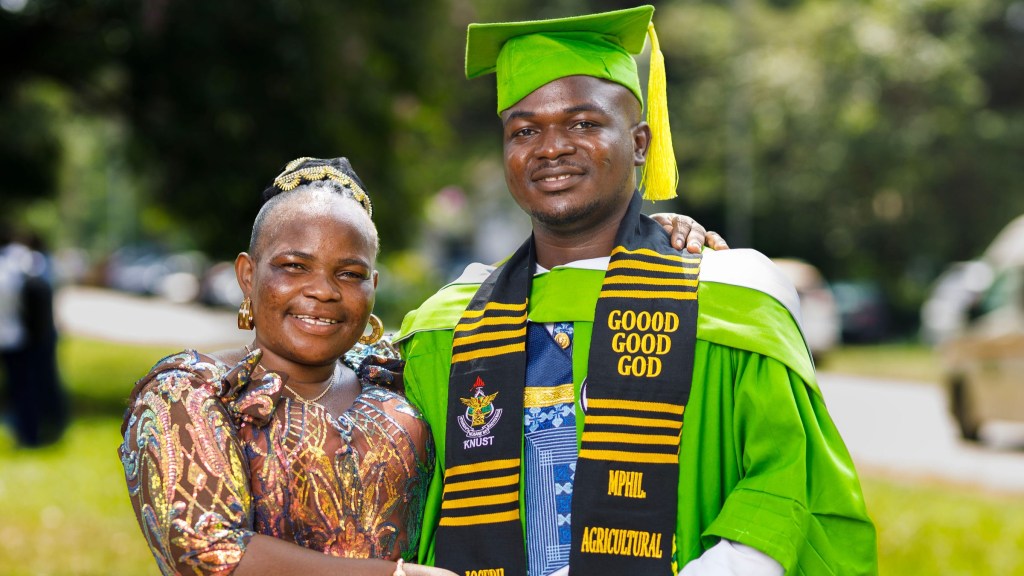
Save for my mother, who went out looking for me, my destiny would have taken a huge turn on that day in 2013 when I chose to pursue the quick returns from gold mining instead of the very life I live now and all that is yet to come. Not only does my surname, Salmawobil, mean “Small Gold Pot,” I was born in a land filled with gold and currently estimated to contain the largest gold deposit in Ghana, one of the world’s richest gold belts—the famed Gold Coast. I was born and bred in Namoalug, in the Talensi District of the Upper East Region of Ghana.
Like many of my counterparts growing up in a land where the evidence that education pays off in the long run is hardly visible, but the successful people around us rely on gold mining, the temptation to trade education for quick money from the mines is a daily reality—one that wins about 90% of the time. Within the district, miners are often the richest, the most generous, and the ones who display the kinds of luxurious lives that naturally attract any teenager. This is unlike the educated people who live around us—mostly teachers or nurses—whose incomes are little to write home about. So, to tell a student who rarely sees an educated wealthy person except during funerals or political campaign seasons that education is a better path than the mines—where one could easily earn up to GHS 1,000 in a week—is like narrating a fairytale that simply will not fly.
I too was moved by this temptation. Even though I was academically good with promising prospects, I wanted to live the kind of life my mates enjoyed and, at the very least, have money of my own. And because I schooled right in a gold-mining community, this temptation never left. Eventually, I made a concrete decision to follow it on Saturday, 30th March 2013. It was the day after our second-term vacation, which meant there would be no school for the next three weeks. Three of my friends had permission from their parents to spend their vacation at the mining site—where my father lived—to earn some money. I decided to join them, without my mother’s knowledge.
That morning, I wore a jacket over my shirt and set off, hiding my plans. We left for the mining community—a path I knew too well—and arrived around 9 a.m. We explored the area and lodged at my father’s residence, where my stepmother and stepbrothers lived. With excitement and curiosity, we hit the ground running, searching for places to work and begin “cashing out.” But the entire day’s effort yielded nothing. Still, the plan was to continue the next day, and that was what I prepared myself for when we returned to rest in the late afternoon.
My anticipation was mixed. I was about to sleep outside my mother’s home for the first time in three years since I moved from my father’s household to hers in the village. But there was also the excitement of finally starting to earn money I could spend in the new term. That anticipation was suddenly cut short when I heard raised voices outside the room in which I rested.
“Where is the boy?” That was my mother’s voice. She had come looking for me and confronted my stepmother and my friends, who denied I was there just to help me accomplish my mission. But with deep conviction, she kept pressing. Her voice drew attention, and I was compelled to come out to avoid further drama.
Instead of following her home immediately, I did something else.
Fearing the beatings that awaited me, I hurried ahead, taking the lead toward home. I got a free ride from a motor rider—a service I relied on almost every school day. He wasn’t going directly toward my village, but he dropped me at Sheaga, leaving me to walk the remaining three kilometers home.
While walking, I reached the church, St. Paul’s Catholic Church, Sheaga and noticed people gathering wood for a bonfire. It was Holy Saturday, but I didn’t know; church was not my thing. I would leave home early on Sunday on many instances and return when I knew they were gone to church. I branched there out of curiosity and helped gather the firewood, which was later burnt before the beginning of the Easter Vigil Mass celebrated by Rev. Fr. Mark Caesar Abanga. During the Mass, my tired body could not endure the long liturgy of nine readings, psalms, and rituals. I slipped into a room opposite the sacristy at the back of the church fell asleep.
I slept until a tap woke me—my mother was in the church. She had continued searching for me there. She waited until Mass ended, then took me home, I didn’t receive my anticipated beatings but verbal advices abounded, which concluded with the chase to go and bath.
While my participation in that night’s liturgy was limited to gathering firewood and sleeping, something within me shifted. I became calmer than I had ever been.
A few months later, I was sent to call my sister home from Catechism, but instead of returning with her, I stayed and joined the class. That marked the beginning of my active participation in the life of the Church. I served Mass for the first time on 17th August 2013 because all the servers had travelled for the Feast of the Assumption at the Kongo Spiritual Renewal Centre, and they needed someone to step in, I only had to wear the cassock that was twice my size and do as the other mass server did. Shortly after, I began reading in church as a Lector in the local language, Talen. A year after the incident, on 14th April 2014, I received the Sacraments of Initiation: Baptism, Confirmation, and First Communion.
The following year, because I was now a baptised Catholic within the Navrongo-Bolgatanga Diocese, I was able to sit for the Notre Dame Seminary Senior High School entrance examination—and gained admission into one of the most prestigious SHS in the country. Without baptism, I would not have qualified. I would have either gone to my initially placement at Zamse Senior High/Technical School or sought help to change my admission to Bolgatanga Senior High School, and my life trajectory would have been very different. From Notre Dame, everything changed, step by step, to what I am today.
Today, I hold a Master of Philosophy in Agricultural Economics at the age of 24, with many accomplishments in leadership, social impact, and personal development. Meanwhile, the very friends whose parents permitted them to pursue quick money at a young age—when I was twelve—are still in the mining site. Only one completed SHS two years ago, and the possibility that he will proceed to the tertiary level is minimal. While I do not ride the motorbikes they own or make the quick money they still earn, I live a more meaningful, purposeful life, with comfortable sources of income—one that, by the grace of God, has allowed me to help others achieve their dreams or begin the journey towards them.
Looking back now, I often ask myself what would have happened if my mother had arrived even an hour later—or if my hiding place had succeeded that day. Perhaps I would have slipped deeper into the mining world, a world that promises quick money but quietly drains the future. Perhaps I would never have moved from the mines to the Mass at St. Paul’s Catholic Church in Sheaga that night, and the quiet transformation that began in my sleep during the Vigil might never have taken root.
I now understand that my mother’s intervention was not merely parental instinct; it was divine orchestration. The very path I was running toward—lured by fast wealth—was the same path many boys entered and never returned from, whether through death, injury, addiction, or an unending cycle of hardship. My escape was not the result of wisdom or strength on my part; it was grace interrupting my direction through a mother who refused to lose her son to the pits.
That single intervention, shaped by a mother’s determination and God’s providence, became the thin line that separated who I could have become from who I ultimately became.
I stand today to celebrate my mother—whose bold pursuit of me, like the Good Shepherd who leaves the ninety-nine in search of the one, changed the trajectory of my life. Her decision set in motion events that led me to Christ and to knowing the Goood, Good God who continues to shape my journey.
PS: My father was never in support of me going into the mines. He was not present when the incident occurred. Had he been there, I would probably have received a much greater beating before my mother even arrived. He committed himself to ensuring that all his children were educated to the highest standards within his means. Even though he was disappointed by those who came first, I stand as a testimony to his efforts. Sadly, he did not live to see my first University graduation, which took place two years after his passing.


 Joe Yapzor
Leave a reply to Edwina Senanu Hadjah Cancel reply